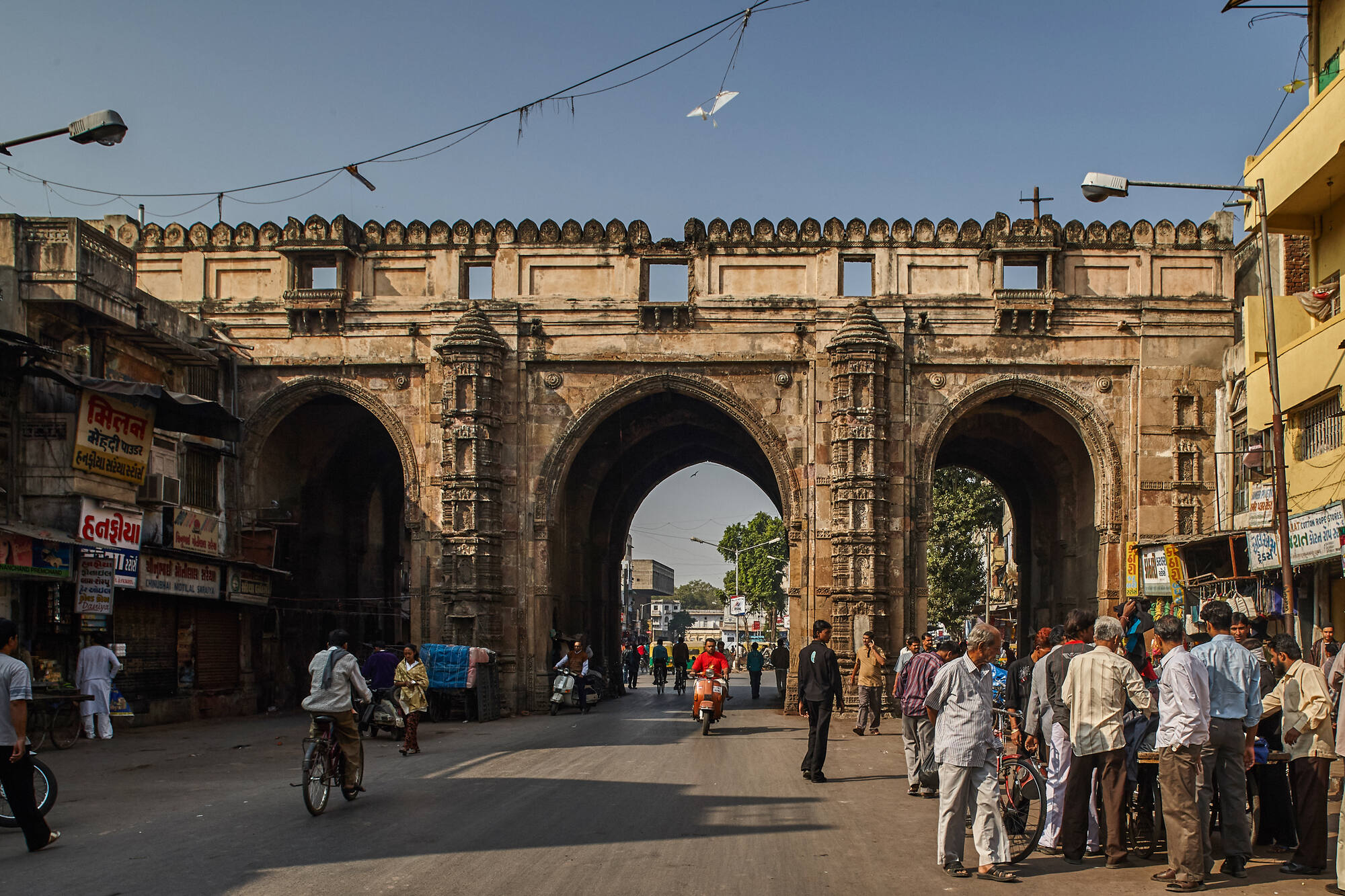
Situated on the banks of the Sabarmati River, the city is known for its historic pols, beautiful mosques, temples, stepwells, museums, textile traditions and lively food culture.
Ahmedabad was founded by Sultan Ahmad Shah in 1411 and has grown from a historic walled city into one of Gujarat's most important commercial and cultural centers. Its historic old city was recognized as India's first UNESCO World Heritage City in 2017.
For travelers, Ahmedabad offers a wide variety of experiences—from walking through the narrow lanes of the old city and visiting Sabarmati Ashram to exploring Adalaj Stepwell, enjoying a traditional Gujarati meal and experiencing the city's famous street food.
History
Ahmedabad has a rich history spanning more than six centuries. The city was founded in 1411 by Sultan Ahmad Shah, who established it as an important center of the Gujarat Sultanate.
The old city developed around the Bhadra Fort and was surrounded by fortified walls with numerous gates. Over time, Ahmedabad became an important center of trade, textiles, craftsmanship and commerce.
The city later came under Mughal and Maratha influence before becoming part of British India.
Ahmedabad also played an important role in India's freedom movement. Mahatma Gandhi established Sabarmati Ashram here, and the city became an important center for India's struggle for independence.
After independence, Ahmedabad became one of Gujarat's most important industrial and commercial cities. Its historic significance was formally recognized when the Historic City of Ahmedabad was declared a UNESCO World Heritage Site in 2017.
Geography
Ahmedabad is located in central Gujarat on the eastern bank of the Sabarmati River.
The city lies in a relatively flat region and has a mostly dry and warm climate.
Ahmedabad generally experiences:
- Hot summers
- Monsoon rainfall
- Pleasant winters
The Sabarmati River has played an important role in the city's development and remains a major part of Ahmedabad's identity.
The city is also well connected to other important destinations in Gujarat, making it a convenient base for exploring the state.
Culture and Traditions
Ahmedabad has a strong Gujarati cultural identity, combined with influences from its Sultanate history, Jain and Hindu traditions, Islamic architecture and modern urban life.
Gujarati is the main language, while Hindi and English are widely spoken.
The city is known for:
- Gujarati traditions
- Jain and Hindu culture
- Islamic heritage
- Textile traditions
- Handicrafts
- Folk music and dance
- Garba
- Traditional markets
- Gujarati cuisine
One of the city's most distinctive features is its pols—traditional residential neighborhoods in the old city with closely packed houses, wooden facades, narrow lanes and community spaces.
Ahmedabad's cultural life becomes particularly lively during Navratri, when Garba and Dandiya celebrations take place across the city.
Architecture
Ahmedabad is one of India's best destinations for architecture lovers.
The city's historic architecture combines Hindu, Jain and Islamic influences, creating a distinctive style often associated with the Gujarat Sultanate period.
Important architectural attractions include:
- Bhadra Fort
- Teen Darwaza
- Sidi Saiyyed Mosque
- Jama Masjid
- Adalaj Stepwell
- Sarkhej Roza
- Historic pol houses
The city is also famous for its modern architecture. Several internationally recognized architects have contributed to Ahmedabad's architectural landscape, including Le Corbusier, Louis Kahn and Charles Correa.
This makes Ahmedabad particularly interesting because visitors can experience medieval architecture alongside important examples of modern architecture.
Famous Places
Sabarmati Ashram
Sabarmati Ashram is one of Ahmedabad's most important landmarks and is closely associated with Mahatma Gandhi.
Located beside the Sabarmati River, the ashram provides insight into Gandhi's life, philosophy and role in India's freedom movement.
Sabarmati Riverfront
The Sabarmati Riverfront has transformed the riverbank into a major urban recreational area.
Visitors can enjoy walking, cycling, gardens, views of the river and various recreational activities. It is particularly pleasant during the evening.
Sidi Saiyyed Mosque
The Sidi Saiyyed Mosque is one of Ahmedabad's most famous architectural landmarks.
It is particularly renowned for its intricate stone jali work, especially the celebrated tree-of-life window carving.
Jama Masjid
Built in 1424, the Jama Masjid is one of the most important historic mosques in Ahmedabad.
Its large courtyard, detailed stonework and impressive columns showcase the architectural traditions of the Gujarat Sultanate.
Bhadra Fort
Bhadra Fort was built by Sultan Ahmad Shah and forms an important part of Ahmedabad's historic core.
The surrounding area is closely connected with the city's old markets and heritage buildings.
Adalaj Stepwell
Located near Ahmedabad, Adalaj Stepwell is one of Gujarat's most remarkable historic structures.
Built in the 15th century, the stepwell features beautifully carved pillars, walls and galleries. Its architecture combines practical water storage with elaborate artistic design.
Kankaria Lake
Kankaria Lake is one of Ahmedabad's most popular recreational attractions.
The area around the lake includes gardens, entertainment facilities, food stalls and activities suitable for families.
Hutheesing Jain Temple
The Hutheesing Jain Temple is a beautifully decorated Jain temple known for its intricate carvings and peaceful atmosphere.
It is an excellent example of Ahmedabad's rich Jain architectural heritage.
Sarkhej Roza
Sarkhej Roza is a historic architectural complex featuring tombs, mosques, pavilions and a large water tank.
The peaceful complex is often described as one of the finest examples of the architectural traditions of medieval Gujarat.
Calico Museum of Textiles
The Calico Museum of Textiles is renowned for its collection of Indian textiles, including traditional fabrics, embroidery and textile art.
It is particularly interesting for travelers interested in Gujarat's long connection with textile production.
Auto World Vintage Car Museum
The Auto World Vintage Car Museum features a large collection of historic automobiles, including luxury cars and vehicles associated with India's royal families.
It is a popular attraction for automobile enthusiasts and families.
Science City
Gujarat Science City is a modern educational and recreational attraction featuring science exhibits, interactive experiences and educational facilities.
It is particularly suitable for families and children.
Famous Dishes
Gujarati Thali
A traditional Gujarati Thali is one of Ahmedabad's most popular food experiences.
It typically includes rotli, vegetables, dal, kadhi, rice, farsan, pickles, chutneys and sweets.
Khaman
Khaman is a soft, steamed Gujarati snack made from gram flour. It is commonly served with chutneys and garnishes.
Dhokla
Dhokla is a light, steamed snack made from fermented batter. It is one of Gujarat's best-known foods.
Fafda-Jalebi
The combination of crispy fafda and sweet jalebi is one of Ahmedabad's most iconic food experiences, particularly popular during festive occasions.
Khandvi
Khandvi consists of thin rolls made from gram flour and yogurt, usually topped with mustard seeds, coconut and coriander.
Dal Dhokli
Dal Dhokli is a comforting Gujarati dish consisting of pieces of wheat dough cooked in a spiced lentil-based preparation.
Sev Tameta
Sev Tameta is a flavorful Gujarati dish made using tomatoes and spices, topped with sev. It is commonly enjoyed with rotli or other Gujarati breads.
Khichdi-Kadhi
The combination of khichdi and kadhi is a classic Gujarati comfort meal and can be found in many traditional restaurants.
Ahmedabad Street Food
Ahmedabad has a particularly strong street-food culture. Popular areas offer snacks such as dabeli, sandwiches, pani puri, pav bhaji, bhajiya and kulfi.
Famous Personalities
Mahatma Gandhi
Mahatma Gandhi is perhaps the most important personality associated with Ahmedabad. He established Sabarmati Ashram and spent significant periods of his life in the city.
Ahmedabad became an important base for his work during India's independence movement.
Sardar Vallabhbhai Patel
Sardar Vallabhbhai Patel, one of India's most important independence leaders and later the country's first Deputy Prime Minister, had a strong association with Ahmedabad and Gujarat.
His role in India's freedom movement and the integration of princely states made him one of the country's most influential historical figures.
Vikram Sarabhai
Dr. Vikram Sarabhai, regarded as one of the pioneers of India's space program, was born in Ahmedabad.
His family and institutions played a major role in developing Ahmedabad as an important center for science and education.
Ravi Shankar
The internationally renowned sitar player Ravi Shankar had strong cultural associations with India and performed widely across the country, while Ahmedabad's cultural institutions have long supported Indian classical music.
Festivals
Navratri
Navratri is one of Ahmedabad's biggest festivals. The city becomes filled with Garba and Dandiya events, colorful traditional clothing and music.
Large community celebrations and organized Garba events attract thousands of participants.
Uttarayan
Ahmedabad is particularly famous for its International Kite Festival around Uttarayan.
The city's skies become filled with colorful kites, while rooftops turn into lively gathering places for families and friends.
Diwali
Diwali is celebrated with lights, decorations, sweets, prayers and family gatherings. Markets become especially lively during the festive period.
Rath Yatra
The annual Jagannath Rath Yatra is one of Ahmedabad's major religious events. A large procession carrying idols of Lord Jagannath, Balabhadra and Subhadra travels through the city.
Janmashtami
Temples across Ahmedabad organize special prayers and celebrations for Lord Krishna during Janmashtami.
Holi
Holi is celebrated with colors, music and social gatherings across the city.
Things to Do
Visitors can enjoy a wide range of experiences in Ahmedabad:
- Explore the historic old city
- Take a heritage walk through the pols
- Visit Sabarmati Ashram
- Walk along the Sabarmati Riverfront
- Explore Bhadra Fort
- Admire the Sidi Saiyyed Mosque
- Visit Adalaj Stepwell
- Explore Sarkhej Roza
- Visit Kankaria Lake
- Try a traditional Gujarati Thali
- Explore Ahmedabad's street food
- Shop for Gujarati textiles and handicrafts
- Visit museums and art galleries
- Explore modern architecture
- Experience Garba during Navratri
- Enjoy the International Kite Festival
- Visit nearby historical destinations
Where to Eat, Shop, and Stay
Where to Eat
Ahmedabad is one of the best cities in Gujarat for experiencing traditional Gujarati food and street food.
Visitors should explore local restaurants and food markets for Gujarati Thali, Khaman, Dhokla, Fafda-Jalebi, Khandvi and Sev Tameta.
For street food, areas such as Manek Chowk are particularly popular for their lively food scene.
Where to Shop
Ahmedabad is famous for textiles and traditional Gujarati products.
Popular shopping areas offer:
- Bandhani fabrics
- Traditional Gujarati clothing
- Handicrafts
- Embroidery
- Jewellery
- Textiles
- Gujarati snacks
- Souvenirs
Law Garden is popular for traditional clothing, handicrafts and colorful Gujarati products.
Where to Stay
Visitors can choose accommodation according to their budget and travel plans.
The city center and western parts of Ahmedabad offer convenient access to restaurants, shopping areas, business districts and major attractions.
Options range from budget hotels and guesthouses to mid-range and luxury properties.
What is Ahmedabad Famous For?
Ahmedabad is particularly famous for:
- UNESCO World Heritage City
- Sabarmati Ashram
- Mahatma Gandhi
- Sabarmati Riverfront
- Sidi Saiyyed Mosque
- Adalaj Stepwell
- Gujarati food
- Manek Chowk
- Navratri Garba
- International Kite Festival
- Textile traditions
- Historic pols
- Jain and Islamic architecture
- Laxmi Vilas-style regional heritage and Gujarati craftsmanship
Its unique character comes from the way history, architecture, food, business, culture and modern urban life coexist.
Best Time to Visit
October to February
Winter is generally the best time to explore Ahmedabad. The weather is more comfortable for heritage walks, sightseeing, shopping and outdoor activities.
January
January is especially exciting because of the International Kite Festival and Uttarayan celebrations.
September to October
Travelers interested in Gujarati culture and Garba should consider visiting during Navratri.
March to May
Summer can become quite hot, particularly during the afternoon. Sightseeing is more comfortable in the mornings and evenings.
June to September
The monsoon brings occasional rainfall and slightly cooler conditions, although outdoor plans may need flexibility.
How to Reach
By Air
Sardar Vallabhbhai Patel International Airport connects Ahmedabad with major Indian cities and several international destinations.
By Train
Ahmedabad Junction is a major railway station with extensive connections to cities across India.
By Road
Ahmedabad has excellent road connectivity with major Gujarat destinations and cities such as Vadodara, Surat, Rajkot, Udaipur and Mumbai.
Nearby Places
Adalaj
Located close to Ahmedabad, Adalaj is famous for its magnificent stepwell and historic architecture.
Gandhinagar
Gujarat's capital city is located near Ahmedabad and is known for its planned layout, gardens, temples and modern institutions.
Modhera
Modhera is famous for the spectacular Sun Temple, an outstanding example of medieval Indian temple architecture.
Patan
Patan is known for the historic Rani ki Vav, a UNESCO World Heritage Site, as well as its traditional Patola textiles.
Nalsarovar
Nalsarovar Bird Sanctuary is a popular destination for nature lovers and bird watchers, particularly during the winter season.
Champaner-Pavagadh
This UNESCO World Heritage destination features historic forts, temples, mosques and archaeological remains.
Best Duration for a Trip
1 Day
A one-day trip can cover Sabarmati Ashram, the Old City, Sidi Saiyyed Mosque, Bhadra Fort, Manek Chowk and Sabarmati Riverfront.
2 Days
Two days allow you to explore the major heritage attractions, food spots, museums, markets and Kankaria Lake at a comfortable pace.
3 Days
Three days provide enough time to explore Ahmedabad thoroughly and add nearby attractions such as Adalaj, Gandhinagar or Nalsarovar.
Travel Tips
- Start heritage sightseeing early, especially during summer.
- Try a traditional Gujarati Thali at least once.
- Explore the old city with a heritage walk for a better understanding of its history.
- Visit Manek Chowk for a lively local food experience.
- Carry comfortable footwear for walking through old-city areas.
- Dress respectfully when visiting religious sites.
- Keep water and sun protection with you during warmer months.
- Book accommodation early during major festivals.
- If visiting during Uttarayan, be careful around rooftops and kite-flying areas.
- Check opening days and timings of museums and heritage attractions before visiting.
Why Visit Ahmedabad?
Ahmedabad is a city where India's past and present meet. Its historic mosques, stepwells, temples and pol houses tell stories of centuries of history, while its museums, universities, modern architecture and thriving business districts represent its contemporary identity.
It is also one of the best places to experience Gujarati food and festivals. From eating fafda-jalebi and Gujarati Thali to watching thousands of kites fill the sky during Uttarayan, Ahmedabad offers experiences that go far beyond conventional sightseeing.
For travelers interested in heritage, architecture, history, food, culture, shopping and festivals, Ahmedabad is one of Gujarat's most rewarding destinations.
Conclusion
Ahmedabad is a city of contrasts and connections. Historic pols stand alongside modern buildings, centuries-old mosques sit near busy markets, and traditional Gujarati food shares space with a rapidly growing urban lifestyle.
Whether you are exploring the legacy of Mahatma Gandhi at Sabarmati Ashram, admiring the stonework of Sidi Saiyyed Mosque, walking through the old city, enjoying a Gujarati Thali or watching kites during Uttarayan, Ahmedabad offers something memorable at every turn.
A trip to Gujarat is incomplete without experiencing the heritage, flavors and vibrant spirit of Ahmedabad.
"Travel is the only thing you buy that makes you richer."