Rajnandgaon, Chhattisgarh: A Cultural City Where Royal Heritage Meets Literature and Tradition
Rajnandgaon is one of Chhattisgarh's most culturally fascinating destinations. Once the capital of a princely state, the city carries traces of royal architecture, historic palaces, literature, temples and traditional Chhattisgarhi culture.
Known for its association with literary giants such as Gajanan Madhav Muktibodh, Padumlal Punnalal Bakshi and Baldev Prasad Mishra, Rajnandgaon offers travellers something beyond conventional sightseeing. Its identity stretches from the historic princely palace and Triveni Museum to the spiritual landscape of Dongargarh and the artistic traditions of Khairagarh.
For travellers interested in heritage, literature, temples, art, culture and short road trips, Rajnandgaon makes an excellent addition to a Chhattisgarh itinerary.
History of Rajnandgaon
Rajnandgaon's history goes back several centuries. The area was historically influenced by the Somvanshis, Kalchuris and Marathas. The city was originally known as Nandgram.
The princely state of Rajnandgaon came into existence around 1830, when a Bairagi Vaishnav Mahant shifted his capital to the present-day Rajnandgaon. The city later developed as the capital of the Rajnandgaon princely state.
During the British period, the rulers of Rajnandgaon received recognition and titles from the British administration. The Mahant rulers continued to govern the princely state, with Mahant Ghasi Das, Mahant Balram Das Bahadur, Mahant Rajendra Das Vaishnav, Mahant Sarveshwar Das Vaishnav and Mahant Digvijay Das Vaishnav among the important names associated with its history.
After independence, the princely state was merged into the administrative structure of Madhya Bharat and later Madhya Pradesh. On 26 January 1973, Rajnandgaon district was created after being separated from the former Durg district.
In 1998, parts of Rajnandgaon were separated to form the new Kabirdham district. After Chhattisgarh became a separate state on 1 November 2000, Rajnandgaon continued as an important district headquarters.
Geography of Rajnandgaon
Rajnandgaon lies in the central part of Chhattisgarh. The landscape includes plains, agricultural areas, forests, hills, water bodies and archaeological sites.
The city is strategically positioned along the major Mumbai–Howrah railway corridor and the historic National Highway 6 route, giving it strong road and rail connectivity.
| Rajnandgaon District at a Glance | Details |
|---|---|
| State | Chhattisgarh |
| District Headquarters | Rajnandgaon |
| District Established | 26 January 1973 |
| Area | 8,022.55 sq km |
| Population, 2011 | 884,742 |
| Male Population | 440,216 |
| Female Population | 444,526 |
| Literacy Rate | 78.46% |
| Sex Ratio | 1,009 females per 1,000 males |
| Population Density | 273 people per sq km |
| Tehsils | 7 |
| Blocks | 4 |
| Villages | 697 |
| Urban Population | 219,688 |
| Rural Population | 665,054 |
Note: The demographic figures above are district-level Census 2011 figures reported by the current district administration.
Culture and Traditions
Rajnandgaon reflects the broader cultural identity of Chhattisgarh, with Chhattisgarhi being an important local language. Folk music, dance, colourful clothing, traditional jewellery and agricultural festivals remain important parts of regional life.
Raut Nacha
Raut Nacha is a traditional folk dance associated with the Yadav/Raut community and is performed during festive occasions.
Panthi
Panthi is a devotional folk dance traditionally associated with the Satnami community. It is recognised for rhythmic movements and spiritual themes.
Pandwani
Pandwani is a traditional storytelling and musical performance based primarily on stories from the Mahabharata. Rajnandgaon's cultural history is closely connected with this wider Chhattisgarhi performance tradition.
Soowa and Dewar Nacha
Soowa and Dewar Nacha are other traditional forms of music and dance found in the region, reflecting the strong connection between folk performance and community life.
Traditional Dress and Jewellery
Traditional clothing is often colourful and accompanied by regional ornaments. Jewellery such as Phuli, Bali, Choora, Kardhani and Bichhiya forms part of traditional attire.
Architecture of Rajnandgaon
Rajnandgaon's architecture reflects its princely-state history and religious traditions. Historic palaces, temples, museums and old structures create a distinctive character within the city.
Princely Palace
The historic Rajnandgaon princely palace is one of the city's most important heritage structures. The building currently houses Government Digvijay College, while the rear portion contains the Triveni Museum.
Triveni Museum
The museum is dedicated to three major literary personalities associated with Rajnandgaon: Gajanan Madhav Muktibodh, Dr. Padumlal Punnalal Bakshi and Dr. Baldev Prasad Mishra.
Historic Temples
The district also contains temple architecture dating from different periods. The official tourism inventory includes the 13th–14th-century Shiv Temple at Gandai and an excavated 11th–12th-century Shiv Temple at Ghatiyari.
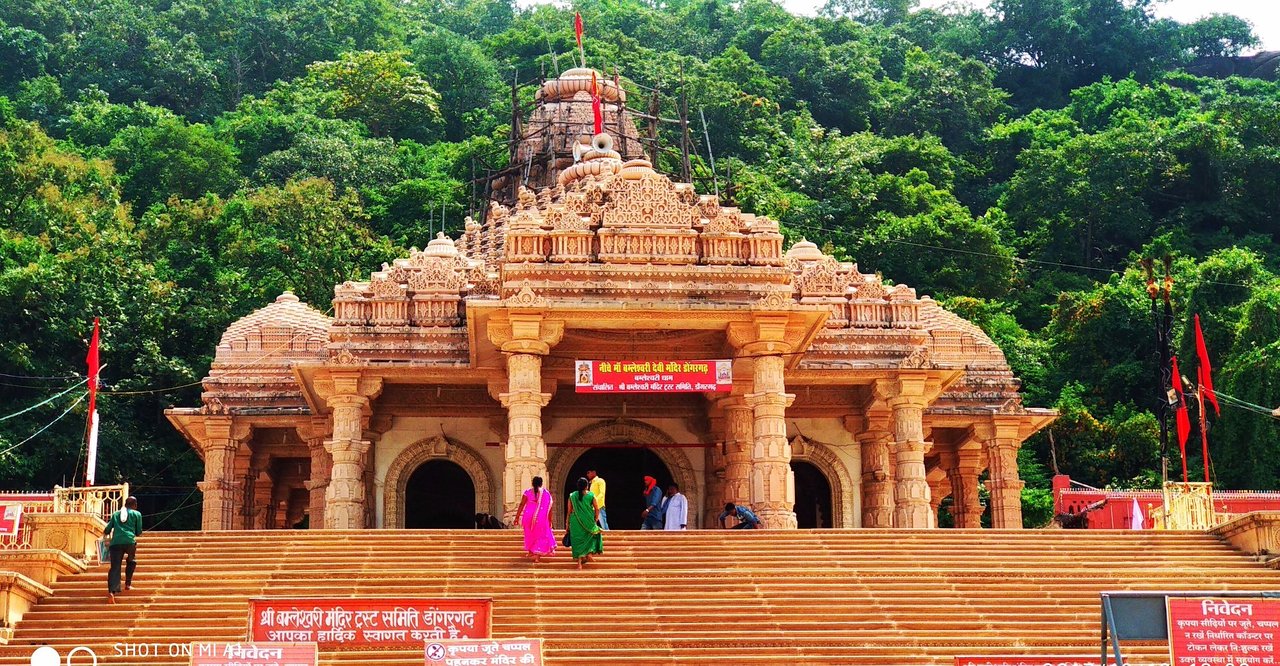
Maa Bamleshwari Temple
The famous temple at Dongargarh sits on a hill approximately 1,600 feet high. Its elevated location, surrounding hills and religious importance make it one of the district's most recognisable landmarks.
Famous Places to Visit in Rajnandgaon
Maa Bamleshwari Temple, Dongargarh
Maa Bamleshwari Temple is perhaps the most famous pilgrimage destination in Rajnandgaon district. Located at Dongargarh, around 35 km west of Rajnandgaon, the temple stands on a hilltop approximately 1,600 feet high. Chhoti Bamleshwari Temple is another important shrine nearby. Navratri attracts large numbers of devotees.
Princely Palace
The historic palace in Rajnandgaon provides an insight into the city's royal past. Today, Government Digvijay College operates from the palace complex, while the rear section houses the Triveni Museum.
Triveni Museum
Triveni Museum preserves the memories, manuscripts, photographs and personal belongings associated with Muktibodh, Bakshi and Baldev Prasad Mishra. The Muktibodh section recreates aspects of the writer's life and literary work.
Mukti Bodh Parisar
Mukti Bodh Parisar, developed near Digvijay College, celebrates Rajnandgaon's literary heritage. It is particularly important for travellers interested in modern Hindi literature.
District Archaeological Museum
The District Archaeological Museum was developed through the district's archaeological association. Its galleries cover archaeology, statues, weapons and tribal/folk art. The collections include ancient coins, stone tools, fossils, mineral specimens, sculptures and traditional objects.
Indira Kala Sangeet Vishwavidyalaya, Khairagarh
Located around 39 km from Rajnandgaon, Indira Kala Sangeet Vishwavidyalaya is one of the district's most distinctive cultural institutions, specialising in music and fine arts. An archaeological museum is also associated with the campus.
Narmada Kund
Located around 62 km from Rajnandgaon, Narmada is known for a natural water source and a temple displaying Maratha-era Panchayatana architectural characteristics.
Dongareshwar Mahadev
Located around 65 km from Rajnandgaon, Dongareshwar Mahadev features a natural cave and a stream of water flowing through rocks. The district tourism page notes that water flows throughout the year from the natural rock formation.
Mandeep Khol
About 85 km from Rajnandgaon, Mandeep Khol combines a natural cave with a water source, making it an interesting option for travellers looking for less-commercialised natural attractions.
Jagannath Temple, Pandadah
Located around 47 km from Rajnandgaon, Pandadah was associated with the Bairagi rulers of the Rajnandgaon princely state and is known for its Jagannath Temple.
Gandai Shiv Temple
The historic Shiv Temple at Gandai is an important archaeological attraction. The district administration dates its construction to approximately the 13th–14th century and highlights its architectural quality.
Ghatiyari Shiv Temple
The excavated Shiv Temple at Ghatiyari is believed to date to approximately the 11th–12th century. Only parts of the original structure, including the foundation and sanctum remains, survive.
Mangata Wildlife Park
Mangata Wildlife Park is an environmental park featuring wildlife and a roughly 2 km nature-tracking path. The district tourism page lists species and birds associated with the park, making it an option for families and nature enthusiasts.
Khaara Reserve Forest
Khaara Reserve Forest offers a more natural experience with forest landscapes, hills, streams and waterfalls. It is particularly attractive during and after the monsoon when the landscape becomes greener.
Kharkhara Dam
Kharkhara Dam is around 99 km by road from Rajnandgaon. The destination includes a dam, surrounding landscapes and a waterfall that becomes particularly scenic during the rainy season.
Famous Dishes to Try in Rajnandgaon
Rajnandgaon's food culture follows the broader Chhattisgarhi culinary tradition. Rice, lentils, seasonal vegetables, forest produce and jaggery-based sweets play an important role in regional food.
Chila
Chila is a savoury rice-based pancake and one of the easiest local dishes for visitors to try.
Faraa
Faraa is a steamed rice-based dish associated with traditional Chhattisgarhi home cooking.
Bara
Bara is a savoury lentil-based snack, often enjoyed with chutney.
Angakar Roti
Angakar Roti is a traditional regional flatbread that pairs well with vegetables, dal and local curries.
Aamat
Aamat is a traditional Chhattisgarhi preparation made with vegetables and regional ingredients. It is worth trying for visitors interested in local cuisine.
Dehrori
Dehrori is a traditional sweet prepared with rice-based ingredients and is popular across Chhattisgarh.
Khurmi
Khurmi is a traditional jaggery-based sweet snack and a good option for travellers looking to sample regional desserts.
Famous Personalities of Rajnandgaon
Gajanan Madhav Muktibodh
Gajanan Madhav Muktibodh is one of the most important literary personalities associated with Rajnandgaon. He served as a professor at Digvijay College and produced some of his most significant literary work during his years in the city. His legacy is preserved through the Mukti Bodh Parisar and Triveni Museum.
Dr. Padumlal Punnalal Bakshi
Dr. Padumlal Punnalal Bakshi was a prominent Hindi writer, teacher and editor. He served as a teacher and professor in institutions connected with Rajnandgaon and contributed extensively to Hindi literature and the literary journal Saraswati.
Dr. Baldev Prasad Mishra
Dr. Baldev Prasad Mishra was born in Rajnandgaon in 1898 and became a distinguished scholar of Hindi literature and Tulsi studies. He also held academic and public positions, including association with Khairagarh's music university.
Kishore Sahu
Kishore Sahu was an actor, director, screenwriter and producer associated with Indian cinema. He acted in more than 20 films and directed numerous films between the 1940s and 1970s.
8. Festivals of Rajnandgaon
Navratri
Navratri is particularly important in the Rajnandgaon region because of the major pilgrimage centre at Dongargarh. Maa Bamleshwari Temple attracts large numbers of devotees during both Sharadiya and Chaitra Navratri celebrations.
Hareli
Hareli marks the beginning of an important festive period in Chhattisgarh. Farmers worship agricultural tools and cattle, while children enjoy traditional Gedi activities.
Pola
Pola is an agricultural festival centred around the worship of bullocks. Traditional clay Nandi figures are also popular among children.
Teeja
Teeja is traditionally associated with women and family customs. Married women pray for the welfare of their husbands and celebrate the festival at their parental homes.
Gouri-Goura
Gouri-Goura is another traditional Chhattisgarhi festival celebrated in the region with community participation and religious customs.
Surti
Surti is listed by the district administration among the traditional festivals of Rajnandgaon and reflects the region's strong folk-cultural traditions.
Things to Do in Rajnandgaon
- Explore the historic princely palace and learn about Rajnandgaon's royal past.
- Visit Triveni Museum to discover the literary legacy of Muktibodh, Bakshi and Baldev Prasad Mishra.
- Explore Mukti Bodh Parisar for a deeper understanding of modern Hindi literature.
- Visit the District Archaeological Museum for sculptures, coins, tools, weapons and folk-art collections.
- Take a pilgrimage trip to Maa Bamleshwari Temple in Dongargarh.
- Explore Khairagarh and its renowned music and fine-arts university.
- Discover ancient temples at Gandai and Ghatiyari.
- Explore Narmada Kund and nearby heritage landscapes.
- Visit Dongareshwar Mahadev for its natural cave and perennial water flow.
- Enjoy nature at Khaara Reserve Forest.
- Visit Mangata Wildlife Park for a family-friendly nature outing.
- Try traditional Chhattisgarhi food such as Chila, Faraa and Bara.
- Explore local markets for regional products and everyday shopping.
Where to Eat, Shop, and Stay in Rajnandgaon
Where to Eat
Rajnandgaon has restaurants, local eateries and snack outlets around the main city and railway-station areas. Travellers should look for places offering Chhattisgarhi dishes, vegetarian meals, snacks and traditional sweets.
For a more authentic regional experience, try local preparations such as Chila, Faraa, Bara and Angakar Roti rather than limiting your food experience to standard restaurant cuisine.
Where to Shop
The city's main markets are useful for clothing, household items, snacks and everyday shopping. Visitors interested in regional crafts can also look for traditional Chhattisgarhi products.
Where to Stay
| Stay Type | Best For |
|---|---|
| Budget Hotels | Solo travellers, students and short stays |
| Mid-Range Hotels | Families and leisure travellers |
| Business Hotels | Business travellers and longer stays |
For sightseeing, staying within Rajnandgaon city is practical because it provides easier access to the railway station, markets, museums and major city attractions.
What is Rajnandgaon Famous For?
Rajnandgaon has a remarkably diverse identity. It is best known for its royal history, literature, temples, art and cultural traditions.
- Rajnandgaon Princely State
- Nandgram – the city's historic name
- Gajanan Madhav Muktibodh
- Padumlal Punnalal Bakshi
- Baldev Prasad Mishra
- Kishore Sahu
- Triveni Museum
- Mukti Bodh Parisar
- Maa Bamleshwari Temple, Dongargarh
- Indira Kala Sangeet Vishwavidyalaya, Khairagarh
- Ancient temples and archaeological sites
- Chhattisgarhi folk culture
Best Time to Visit Rajnandgaon
The best time to visit Rajnandgaon is generally from October to February, when the weather is more comfortable for sightseeing, temple visits and outdoor excursions.
| Season | Travel Experience |
|---|---|
| October–November | Good weather and excellent time for sightseeing and festivals |
| December–February | Cooler weather; ideal for city and heritage exploration |
| March–June | Hotter conditions; outdoor trips are better in mornings and evenings |
| July–September | Green landscapes, waterfalls and forests become more scenic, but rain can affect travel |
Festival tip: If your main interest is religious tourism, plan around Navratri to experience the atmosphere around Maa Bamleshwari Temple in Dongargarh. Expect larger crowds during major festival days.
How to Reach Rajnandgaon
By Train
Rajnandgaon Railway Station (RJN) is one of the city's biggest connectivity advantages. The station lies on the Mumbai–Howrah railway route and receives regular trains from major cities including Delhi, Mumbai, Kolkata, Chennai, Bengaluru, Ahmedabad and Raipur.
By Road
Rajnandgaon is connected by major highways and lies on the historic NH 6 route. The district administration states that the city is approximately 72 km from Raipur and around 212 km from Nagpur.
By Air
The nearest major airport is Swami Vivekananda Airport, Raipur, approximately 72 km from Rajnandgaon according to the district administration. From the airport, travellers can continue by road or rail.
| Mode | Practical Option |
|---|---|
| Train | Rajnandgaon Railway Station (RJN) |
| Air | Swami Vivekananda Airport, Raipur |
| Road | NH 6 / major road connections |
Nearby Places to Visit from Rajnandgaon
Dongargarh
Approximately 35–40 km from Rajnandgaon, Dongargarh is the district's major pilgrimage destination and home to Maa Bamleshwari Temple. The hilltop setting makes it particularly attractive for photography and scenic views.
Khairagarh
About 39 km from Rajnandgaon, Khairagarh is known for Indira Kala Sangeet Vishwavidyalaya and its association with music and fine arts.
Pandadah
Approximately 47 km from Rajnandgaon, Pandadah is associated with the old Bairagi rulers and is known for its Jagannath Temple.
Narmada
Approximately 62 km away, Narmada offers a natural water source and a historic temple associated with Maratha-era architecture.
Gandai
About 74 km north of Rajnandgaon, Gandai is important for its historic Shiv Temple dating to the 13th–14th century.
Ghatiyari
Approximately 79 km from Rajnandgaon, Ghatiyari contains archaeological remains of an 11th–12th-century Shiv Temple.
Mandeep Khol
Approximately 85 km from the city, Mandeep Khol offers a natural cave and water source for travellers interested in offbeat landscapes.
Best Duration for a Rajnandgaon Trip
A 2-day trip is enough for the major attractions around Rajnandgaon city. A 3-day itinerary is better if you want to add Dongargarh, Khairagarh and nature destinations.
| Duration | Suggested Plan |
|---|---|
| 1 Day | Princely Palace, Triveni Museum, Mukti Bodh Parisar and city sightseeing |
| 2 Days | City heritage + Dongargarh + local food and markets |
| 3 Days | Rajnandgaon + Dongargarh + Khairagarh + archaeological/nature site |
| 4 Days+ | Rajnandgaon + wider Chhattisgarh cultural and nature circuit |
Travel Tips for Rajnandgaon
- Plan temple and outdoor sightseeing during the morning or late afternoon in summer.
- Carry comfortable footwear for hill temples, forests and archaeological sites.
- Keep drinking water with you for longer road excursions.
- If visiting Dongargarh during Navratri, expect significant crowds and plan accordingly.
- Respect temple customs and dress appropriately at religious sites.
- Check local access conditions before travelling to forest and remote cave locations.
- For archaeological sites, avoid touching or damaging old structures and artefacts.
- Ask permission before photographing local people, artisans or religious ceremonies.
- Try regional Chhattisgarhi food from established local eateries.
- Check current opening hours before visiting museums and cultural institutions.
- Keep extra time for road travel when combining multiple district attractions.
- During monsoon, check rainfall and road conditions before visiting forest, waterfall and cave destinations.
Why Visit Rajnandgaon?
Rajnandgaon is ideal for travellers who enjoy destinations with a strong cultural personality. Its appeal goes beyond temples and sightseeing because the city has an unusually rich literary and artistic heritage.
You can explore a former princely palace in the morning, visit a museum dedicated to major Hindi writers, discover ancient temple architecture and then travel towards the hilltop shrine of Maa Bamleshwari.
The presence of Khairagarh's music university, Dongargarh's pilgrimage landscape, archaeological sites and Chhattisgarhi folk traditions gives the district a diverse travel experience.
If you prefer destinations that combine history, literature, religion, art, culture and nature, Rajnandgaon is worth adding to your Chhattisgarh travel plan.
Conclusion
Rajnandgaon is a destination where the royal history of a former princely state meets the intellectual world of Hindi literature and the living traditions of Chhattisgarh.
From the Princely Palace, Triveni Museum and Mukti Bodh Parisar to Maa Bamleshwari Temple, Khairagarh's artistic heritage and ancient archaeological sites, the district offers a rewarding combination of experiences.
For travellers looking beyond the usual Chhattisgarh destinations, Rajnandgaon provides a slower, more cultural journey through heritage, literature, temples, art, food and regional traditions.
Rajnandgaon Travel Snapshot
| Travel Factor | Details |
|---|---|
| Destination | Rajnandgaon, Chhattisgarh |
| District Established | 26 January 1973 |
| Historic Name | Nandgram |
| District Area | 8,022.55 sq km |
| District Population, 2011 | 884,742 |
| Literacy Rate | 78.46% |
| Sex Ratio | 1,009 females per 1,000 males |
| Best For | Heritage, Literature, Temples, Art, Culture and Nature |
| Major Heritage Attraction | Rajnandgaon Princely Palace |
| Major Museum | Triveni Museum / District Archaeological Museum |
| Major Pilgrimage | Maa Bamleshwari Temple, Dongargarh |
| Major Art Destination | Indira Kala Sangeet Vishwavidyalaya, Khairagarh |
| Popular Nature Sites | Khaara Reserve Forest, Dongareshwar, Mandeep Khol |
| Best Months | October to February |
| Ideal Duration | 2–3 Days |
| Railway Station | Rajnandgaon (RJN) |
| Nearest Major Airport | Swami Vivekananda Airport, Raipur |
"Travel is the only thing you buy that makes you richer."