Introduction
Few cities in India carry the spiritual weight and historical significance that Gaya does. Located in the southern part of Bihar, Gaya is regarded as one of the most sacred cities for Hindus, Buddhists, and pilgrims from across the world. It is a city where ancient rituals, world religions, and living traditions converge in a way that few other places on earth can match. Home to the revered Vishnupad Temple and situated just a short distance from Bodh Gaya, the place where Lord Buddha attained enlightenment, Gaya stands as a unique confluence of Hindu and Buddhist heritage.
In this detailed guide by aonego, we take you on a comprehensive journey through Gaya's history, religious significance, culture, cuisine, major attractions, and everything you need to know before planning your visit to this extraordinary city.
Geographical Overview of Gaya
Gaya district is located in the southern part of Bihar, approximately 100 kilometers south of the state capital, Patna. The city is situated on the banks of the Falgu River, a river that holds immense religious significance in Hindu mythology and rituals. Gaya is bordered by Jehanabad and Nalanda to the north, Aurangabad to the west, Nawada to the east, and shares its southern boundary with the state of Jharkhand.
The district's terrain is a mix of fertile plains and rocky hillocks, with the Barabar Hills and other rocky outcrops giving the region a distinct topography compared to the flatter plains of northern Bihar. This geographical diversity has played an important role in shaping the district's history, from ancient rock-cut caves to fertile agricultural land that has sustained settlements for thousands of years.
Historical Significance of Gaya
Gaya's history stretches back thousands of years, making it one of the oldest continuously inhabited regions in India. The city finds mention in ancient Hindu scriptures, including the Ramayana, Mahabharata, and various Puranas, where it is described as a sacred place for performing ancestral rites.
Ancient and Mythological History
According to Hindu mythology, Gaya derives its name from the demon Gayasura, who, after performing intense penance, was granted a boon that anyone touching his body would attain moksha (liberation). This led to chaos as people began dying just to attain salvation instantly. To resolve this, the gods requested Gayasura to lie down, and Lord Vishnu placed his foot on him to keep him pinned to the earth. This spot is believed to be the location of the present-day Vishnupad Temple, and it is why performing rituals in Gaya is considered to grant moksha to one's ancestors.
Buddhist Connection
Gaya's significance extends beyond Hindu mythology into Buddhist history as well. Just a few kilometers from Gaya city lies Bodh Gaya, where Prince Siddhartha meditated under the Bodhi Tree and attained enlightenment, becoming the Buddha. This makes the greater Gaya region one of the most important pilgrimage destinations for Buddhists worldwide, alongside Lumbini, Sarnath, and Kushinagar.
Historical and Colonial Era
During the medieval period, Gaya continued to be an important religious and administrative center. Under Mughal rule, the region maintained its religious significance while also serving administrative functions. During British colonial rule, Gaya was established as a district headquarters and grew as a center for trade, religious tourism, and pilgrimage-related commerce, a character it retains strongly to this day.
Gaya as a Center of Hindu Pilgrimage: The Significance of Pind Daan
Perhaps nothing defines Gaya's identity more than its association with Pind Daan, the ritual of offering prayers and oblations for the peace of departed ancestors' souls. Hindus from across India and even overseas travel to Gaya specifically to perform this ritual, believing that it is only in Gaya that the souls of ancestors can attain complete liberation (moksha).
The Ritual Process
Pind Daan in Gaya typically involves a series of rituals performed over multiple days at various sacred sites (known as Gaya Shraddha Sthals) across the city, including the banks of the Falgu River, Vishnupad Temple, and other designated locations. Pandas (priest families who have performed these rituals for generations) guide pilgrims through the elaborate rituals, which include offering rice balls (pind), water, and prayers for the peace of ancestors' souls.
This tradition has continued uninterrupted for centuries and remains a significant source of religious tourism and local economy for the city. The period of Pitru Paksha, a fortnight in the Hindu calendar dedicated to ancestor worship, sees the largest influx of pilgrims to Gaya, with lakhs of devotees visiting the city during this time.
Major Places to Visit in Gaya
Gaya offers an incredible range of religious, historical, and natural attractions. Here's a detailed look at the must-visit places in and around the city.
1. Vishnupad Temple
The Vishnupad Temple is the most important religious site in Gaya, built on the banks of the Falgu River. The temple houses a footprint believed to be that of Lord Vishnu, imprinted on a rock. The current structure was built in 1787 by Ahilyabai Holkar, the Maratha queen of Indore, and stands as an architectural marvel with its towering shikhara. Thousands of pilgrims visit this temple daily, and it becomes especially crowded during Pitru Paksha.
2. Bodh Gaya
Located about 12 kilometers from Gaya city, Bodh Gaya is a UNESCO World Heritage Site and one of the most important Buddhist pilgrimage destinations in the world. The Mahabodhi Temple Complex, built around the sacred Bodhi Tree under which Buddha attained enlightenment, attracts monks, tourists, and pilgrims from countries like Japan, Thailand, Sri Lanka, Myanmar, and Bhutan. The complex includes various monasteries built by different countries, each reflecting unique architectural styles from their respective Buddhist traditions.
3. The Bodhi Tree
Within the Mahabodhi Temple complex stands the sacred Bodhi Tree, believed to be a direct descendant of the original tree under which Buddha meditated. Pilgrims and visitors often sit in quiet meditation beneath this tree, seeking spiritual solace in one of the most peaceful settings in India.
4. Barabar Caves
Located about 24 kilometers from Gaya, the Barabar Caves are among the oldest surviving rock-cut caves in India, dating back to the Mauryan Empire (3rd century BCE). Commissioned by Emperor Ashoka, these caves were originally used by the Ajivika sect of ascetics. The caves are renowned for their polished granite interiors, which create a remarkable echo effect, and are considered an engineering marvel of ancient India.
5. Sujata Stupa
Located in Bakraur village near Bodh Gaya, this stupa marks the spot where Sujata, a village girl, offered a bowl of rice milk to Siddhartha before his enlightenment, ending his period of extreme asceticism. This site holds significant importance in the Buddhist narrative of the path to enlightenment.
6. Dungeshwari Cave Temple (Mahakala Caves)
Also known as the Mahakala Caves, these caves are believed to be where Siddhartha practiced extreme austerity and meditation for six years before realizing that the path to enlightenment lay in moderation. Today, the site includes a temple and statue commemorating this period of Buddha's spiritual journey.
7. Brahmayoni Hill
This hillock offers panoramic views of Gaya city and is considered sacred, believed to be the place where Buddha delivered the Fire Sermon (Adittapariyaya Sutta). Visitors can climb the steps to the top, where a small temple and Buddhist stupa are located.
8. Great Buddha Statue
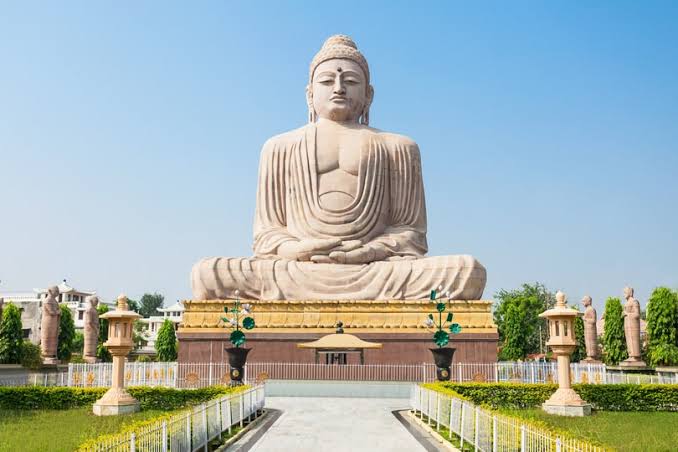
Located in Bodh Gaya, the Great Buddha Statue stands at 80 feet tall and is one of the tallest Buddha statues in India. Built with red granite and sandstone, this statue was consecrated by the Dalai Lama in 1989 and has since become an iconic landmark of the region.
9. Tibetan Monastery and other International Monasteries
Bodh Gaya is home to numerous monasteries built by Buddhist communities from around the world, including the Tibetan Monastery, Thai Monastery, Japanese Temple (Indosan Nipponji), and the Bhutanese Monastery. Each of these structures showcases distinct architectural styles from their respective countries and offers visitors insight into the diversity of global Buddhist traditions.
10. Falgu River
The Falgu River, though often dry on the surface for most of the year, holds immense religious importance. According to legend, the river was cursed by Sita during the Ramayana period, which is why water flows beneath its sandy surface rather than above it. Pilgrims perform rituals along its banks as part of the Pind Daan ceremonies.
Culture and Traditions of Gaya
Gaya's culture is deeply intertwined with its religious identity, but it also reflects the broader Magadh cultural heritage of southern Bihar. The city has historically been a melting pot of Hindu, Buddhist, and even Jain traditions, given the presence of important religious sites for all three faiths within the wider region.
Festivals
- Pitru Paksha Mela – The most significant religious event in Gaya, drawing lakhs of pilgrims for Pind Daan rituals over a 15-day period.
- Buddha Purnima – Celebrated with great fervor in Bodh Gaya, marking the birth, enlightenment, and death anniversary of Buddha. Thousands of Buddhist monks and devotees gather at the Mahabodhi Temple for prayers and celebrations.
- Chhath Puja – As in the rest of Bihar, Chhath Puja is celebrated with immense devotion, with the Falgu River and other water bodies becoming centers of ritual activity.
- Kartik Purnima – Another important occasion when devotees gather for ritual bathing and prayers.
Local Arts and Crafts
Gaya is also known for its traditional crafts, including stone carving (influenced by its historical connection to rock-cut architecture like the Barabar Caves) and handicrafts related to religious paraphernalia used in Pind Daan and temple rituals.
Local Cuisine of Gaya
Food in Gaya reflects the broader culinary traditions of the Magadh region of Bihar, with a few local specialties that visitors should not miss:
- Litti Chokha – The signature dish of Bihar, widely available across Gaya's local eateries and street stalls.
- Tilkut – A famous sweet made from sesame seeds and jaggery, Gaya's Tilkut is particularly renowned and sold widely, especially during winter and festive seasons like Makar Sankranti.
- Khaja – A popular sweet delicacy, especially associated with religious offerings and festive occasions in the region.
- Sattu Paratha and Sattu Sharbat – A protein-rich staple, especially popular during summer months for its cooling properties.
- Anarsa – A traditional sweet made from rice flour and jaggery, commonly prepared during festivals.
- Vegetarian Thali – Given the large number of pilgrims visiting the city, Gaya has a strong tradition of pure vegetarian food, with many eateries near the temples serving traditional thalis suited for pilgrims performing religious rituals.
Bodh Gaya, given its international Buddhist community, also offers a variety of Tibetan and Thai cuisine, with momos, thukpa, and other Tibetan dishes widely available near the monastery areas, catering to the diverse crowd of monks and international tourists.
Economy of Gaya
Gaya's economy is unique in that it is heavily driven by religious tourism. The continuous flow of pilgrims for Pind Daan rituals, combined with the international tourist footfall in Bodh Gaya, generates substantial economic activity for local businesses, hotels, guesthouses, and the priest community.
Beyond religious tourism, Gaya's economy also relies on agriculture, with rice, wheat, and pulses being the primary crops cultivated in the district. Small-scale industries related to handicrafts, particularly items used in religious rituals, also contribute to the local economy.
In recent years, digital transformation has begun reaching even traditional pilgrimage economies like Gaya. Platforms such as aonego are playing an increasingly important role in helping local businesses, hotels, and service providers in Gaya establish an online presence, allowing them to reach pilgrims and tourists planning their visits in advance, thereby modernizing the traditional pilgrimage economy for a digital-first generation of travelers.
Education and Infrastructure in Gaya
Gaya has developed considerably in terms of educational infrastructure over the years. The city is home to Magadh University, one of the prominent universities in Bihar, along with several government and private colleges offering education across various disciplines.
The city's infrastructure has also seen significant investment due to its status as an international pilgrimage destination. Gaya Airport (Bodh Gaya International Airport) is one of the few airports in Bihar with international connectivity, primarily serving the large number of Buddhist pilgrims arriving from countries like Sri Lanka, Thailand, Myanmar, and Japan.
How to Reach Gaya
By Air
Gaya Airport, also known as Bodh Gaya International Airport, is one of the most important airports in Bihar due to its international connectivity, particularly with flights connecting to Buddhist-majority countries. This makes Gaya one of the few cities in Bihar accessible via direct international flights, in addition to domestic connections from major Indian cities.
By Rail
Gaya Junction is a major railway station on the Grand Chord line, connecting the city to Delhi, Kolkata, Mumbai, and other major cities across India. Given its religious importance, Gaya Junction sees heavy footfall throughout the year, especially during the Pitru Paksha season.
By Road
Gaya is well connected by National Highways to Patna, Aurangabad, and other major cities in Bihar and neighboring Jharkhand. Regular bus services, both government and private, operate frequently, making road travel a convenient and popular option for visitors, particularly those traveling from nearby states.
Best Time to Visit Gaya
The best time to visit Gaya is during the winter months from October to March, when the weather is pleasant and conducive to sightseeing and religious activities. The Pitru Paksha period (usually falling in September) is the busiest time for Hindu pilgrims performing Pind Daan, while Buddha Purnima (April/May) is the peak season for Buddhist pilgrims visiting Bodh Gaya. Travelers looking for a quieter, more contemplative experience might prefer visiting during the off-peak months, though the pleasant winter weather remains the most popular choice among visitors.
Tips for Travelers Visiting Gaya
- Respect religious customs: Since Gaya is primarily a pilgrimage destination, visitors should dress modestly and be respectful of ongoing rituals, particularly around the Vishnupad Temple and Falgu River ghats.
- Plan ahead during Pitru Paksha: If visiting during this period, book accommodations well in advance, as the city sees an enormous influx of pilgrims.
- Explore both Gaya and Bodh Gaya together: Since the two are located close to each other, most travelers combine visits to both destinations in a single trip.
- Try local sweets: Don't leave without tasting Gaya's famous Tilkut and other traditional sweets, which make for great souvenirs as well.
- Hire local guides or pandas if performing rituals: For those visiting specifically to perform Pind Daan, engaging with the local Panda community (traditional priest families) is essential, as they are well-versed in the elaborate ritual processes.
Conclusion
Gaya is far more than just another city in Bihar — it is a living testament to India's spiritual and historical depth. From the sacred rituals performed at the Vishnupad Temple to the profound tranquility of the Mahabodhi Temple in Bodh Gaya, Gaya offers an experience that transcends ordinary travel. It is a place where Hindu traditions of ancestor worship and Buddhist pursuits of enlightenment coexist within the same sacred landscape, drawing pilgrims and travelers from every corner of the globe.
Whether you are visiting to perform Pind Daan for your ancestors, seeking spiritual enlightenment at Bodh Gaya, or simply exploring the rich history and culture of southern Bihar, Gaya promises an unforgettable and deeply meaningful journey.
We hope this detailed aonego guide has given you a thorough understanding of Gaya's history, culture, attractions, and everything you need to plan your visit. Stay connected with aonego for more comprehensive travel guides covering the diverse and fascinating districts of Bihar.
"Travel is the only thing you buy that makes you richer."