Dhenkanal — Where a 14-Year-Old Martyr and Odisha's First Woman CM Were Born
Introduction
Dhenkanal carries its history in layers few Odisha towns can match. Named after a medieval Savara chieftain called Dhenka, this former princely capital sits at the foot of Kapilash Hill, home to a Shiva shrine so revered it's called the "Second Kailash." But Dhenkanal's real distinction lies in its people — this quiet, forest-fringed district gave India one of its youngest freedom martyrs, gave Odisha its first and only woman Chief Minister, and gave the state its first woman to summit Mount Everest. Between imposing royal palaces, ancient temples, and a genuine wildlife sanctuary, Dhenkanal offers substance well beyond its market-town reputation for rice, oilseeds, and handloom weaving.
History
Dhenkanal takes its name from Dhenka, a medieval chieftain of the Savara people who once ruled over this tract of land — a detail still central to how locals understand the town's origins. The wider region developed under the Bhoi dynasty, whose rulers governed the princely state of Dhenkanal with a long, rich history of strong kings dating back to the 15th and 16th centuries.
Dhenkanal served as the capital of this princely state until it was formally incorporated into what became Odisha state in 1949–1950, following India's independence. The district's freedom-struggle legacy runs particularly deep here — Baji Rout, a 12-year-old boatman who defied British police orders during the Quit India Movement in 1938, was shot and killed at Nilakanthapur village, becoming one of the youngest martyrs in India's entire independence movement. Today, the district's imposing palaces, forts, and archaeological remains stand as reminders of both its royal past and its role in the freedom struggle.
Geography
Dhenkanal sits in the centrally located, east-central part of Odisha, bordered by Kendujhar and Angul districts to the north, Jajpur district to the east, Cuttack district to the south, and Angul district to the west. The nearest airport, Biju Patnaik International Airport in Bhubaneswar, lies roughly 52 km away.
The district's terrain is mainly plains, though several discontinuous hill ranges run along its southern border, most notably Kapilash Hill, rising to about 1,500 feet and overlooking the Mahanadi River near Cuttack. Much of the region is covered in dense forest, watered by rivers including the Brahmani and Mahanadi, creating genuine habitat for diverse flora and fauna within the Kapilasa Wildlife Sanctuary, a 125.5 sq km reserve designated in 2011. The district's climate follows a tropical wet-and-dry pattern, with annual rainfall of around 1,421 mm.
Culture and Traditions
Dhenkanal's culture is deeply rooted in its identity as a former princely capital, with Odia as the official language and a literacy rate of around 79%. The town has long functioned as a marketplace for rice, oilseeds, and timber, and remains a recognized center of handloom weaving, tying its everyday commerce closely to traditional craft.
Religious life here blends mainstream Hindu devotion with the distinctive Mahima Dharma tradition, founded and headquartered at nearby Joranda, which draws pilgrims to its Samadhi Pitha and surrounding shrines. The district's cultural calendar is also shaped by its rich tradition of fairs and festivals, with Gajalaxmi Puja standing out as one of Dhenkanal's most widely celebrated local traditions.
Architecture
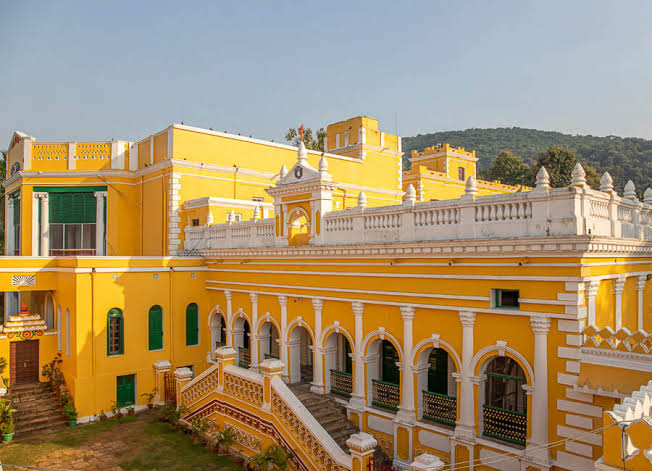
Dhenkanal's architecture centers on its royal legacy, most visibly in Dhenkanal Palace, the official residence of the Bhoi dynasty rulers, built in the latter part of the 19th century and still owned by the descendant royal family today — remarkably, it was converted into a homestay in 1992, allowing visitors to actually stay within its historic walls.
Temple architecture reaches its peak at the Kapilash Temple, also known as Mahadev Chandrashekhar Temple, constructed in 1246 CE by King Narasinghdeva I of the Ganga Dynasty. Standing at a height of roughly 2,239 feet above sea level, its main tower rises 60 feet, and the temple is traditionally regarded as the ashram of the sage Kapila, with some scholars considering it a second Mount Kailash. Further religious architecture is found at Joranda, headquarters of Mahima Dharma, where the Sunya Mandira, Gadi Mandira, and Dhuni Mandira form a distinctive complex around the 96-foot Samadhi Pitha of Mahima Swami.
Famous Places
Kapilash Temple
Perched atop Kapilash Hill roughly 26 km from Dhenkanal town, this 1246 CE temple dedicated to Lord Chandrasekhar (Shiva) is one of the most revered Saiva Pithas of Odisha, often called the "Second Kailash." Visitors can reach it by climbing 1,352 steps or via the twisting Barabanki road route, with Marichi Kunda and Payamruta Kunda flanking the main shrine.
A Site of Deep Religious Significance
Tradition holds this was once the ashram of the sage Kapila, and Shridhar Swami, the renowned commentator on the Bhagavata Purana, is said to have stayed here — adding significant scriptural weight to the temple's spiritual reputation.
Best Time to Visit
Mahashivaratri draws the temple's largest crowds for the annual Jagar Yatra, making it the most immersive time to visit, though quieter visits are better suited for reflection outside this period.
Quick Tip
Pace yourself for the 1,352-step climb, or opt for the twisting Barabanki road route if you prefer a gentler ascent, and combine your visit with the nearby Deer Park and Science Park.
Dhenkanal Palace
The official palace of the Bhoi dynasty rulers of the former Dhenkanal princely state, built in the late 19th century and still owned by the royal family today. Converted into a homestay in 1992, it offers visitors the rare opportunity to actually stay within a genuine royal Odisha residence.
Joranda (Mahima Dharma Headquarters)
Located about 24 km from Dhenkanal, Joranda is the religious headquarters of Mahima Dharma, housing the 96-foot Samadhi Pitha of Mahima Swami, the founder of the faith, alongside the Sunya Mandira, Gadi Mandira, and Dhuni Mandira, drawing large pilgrim crowds during the annual Joranda fair.
Saptasajya Hill
A place of genuine scenic beauty within Dhenkanal district, Saptasajya offers visitors a peaceful natural retreat amid the district's forested hill terrain.
Nandinia Waterfall
Located about 5 km from Hindol and roughly 56 km from Dhenkanal town, this waterfall is reached via a scenic 2-3 km walk on a mountain road, with a cave near the falls housing worship of Lord Jagannath, Balabhadra, and Goddess Subhadra — a striking combination of natural beauty and religious devotion, especially popular during winter.
Kapilasa Wildlife Sanctuary
Spread across 125.5 sq km in the Chota Nagpur Plateau region, this sanctuary was designated in 2011 and offers a genuine wilderness experience within the Eastern Highlands moist deciduous forest ecoregion, home to diverse flora and fauna.
Famous Dishes
Pakhala
A fermented rice dish eaten with vegetables and curd, cherished across Dhenkanal and the wider Odisha region for its cooling effect during the district's hot summer months.
Dalma
A hearty lentil and vegetable stew, forming a comforting staple of everyday Odia meals found throughout Dhenkanal's local eateries.
Chakuli Pitha
A savory rice-and-lentil pancake typically eaten for breakfast, representing the everyday food culture of Dhenkanal's surrounding villages.
Local Rice and Oilseed Specialties
Given Dhenkanal's identity as a marketplace for rice, oilseeds, and timber, dishes built around locally grown rice and oilseed products remain a genuine point of regional culinary pride.
Famous Personalities
Baji Rout
Born in Nilakanthapur village, Dhenkanal district, Baji Rout was a 12-year-old boatman who became one of the youngest martyrs of India's freedom struggle. In 1938, during the Quit India Movement, he refused to ferry British police across the river to suppress local protesters and was shot dead for his defiance, becoming an enduring symbol of courage in Odisha's independence history.
A Symbol of Fearless Youth
Despite his young age, Rout's refusal to cooperate with colonial authorities has made him one of the most remembered child martyrs in India's freedom movement, still honored across Odisha today.
Connection to Dhenkanal
Nilakanthapur, the village where he was shot, remains a site of local memory and pride within Dhenkanal district, tying his sacrifice directly to the region's freedom-struggle legacy.
Fast Fact
His story remains taught in Odisha's schools as a defining example of courage against colonial rule, regardless of age.
Nandini Satpathy
Born in Dhenkanal district, Nandini Satpathy made history as the first and only woman to serve as Chief Minister of Odisha, leaving a lasting mark on the state's political landscape as one of its most significant modern leaders.
Festivals
Gajalaxmi Puja
Dhenkanal's most widely celebrated local festival, beginning on Kumar Purnima and continuing for eleven days, drawing genuine community participation across the district.
Mahashivaratri (Jagar Yatra)
Celebrated with particular grandeur at Kapilash Temple, this festival draws large numbers of pilgrims each year for a night of devotion honoring Lord Chandrasekhar.
Dussehra
Especially notable in Kamakhyanagar within Dhenkanal district, Dussehra brings vibrant community celebrations and religious observance to the wider district.
Things to Do
- Climb (or drive to) Kapilash Temple, one of Odisha's most revered Saiva Pithas.
- Stay at Dhenkanal Palace, a genuine royal Odisha homestay experience.
- Visit Joranda, the spiritual headquarters of Mahima Dharma.
- Explore Kapilasa Wildlife Sanctuary, a genuine forest wilderness experience.
- Trek to Nandinia Waterfall, combining scenic beauty with cave-temple devotion.
- Relax at Saptasajya Hill, a peaceful natural retreat.
- Shop for local handloom textiles, reflecting Dhenkanal's weaving heritage.
Where to Eat, Shop, and Stay
Eat: Local eateries across Dhenkanal serve authentic Odia staples like Dalma and Pakhala, alongside dishes reflecting the district's rice and oilseed trading identity.
Shop: Dhenkanal remains a recognized center of handloom weaving, with local markets offering genuine textiles alongside everyday rice and oilseed produce.
Stay:
- Budget: Simple guesthouses and small hotels cover most short-stay needs for travelers passing through.
- Mid-range: A handful of comfortable hotels near the town center offer better amenities for a more relaxed stay.
- Luxury: For a genuinely unique stay, Dhenkanal Palace itself operates as a heritage homestay, offering visitors the rare chance to stay within an actual royal Odisha residence.
What is Dhenkanal Famous For?
Dhenkanal is best known for Kapilash Temple, one of Odisha's most revered Shiva shrines, and its former status as the capital of the Bhoi dynasty's princely state. It's also recognized as the birthplace of freedom martyr Baji Rout, Odisha's first woman Chief Minister Nandini Satpathy, and its identity as a handloom weaving and grain trading hub.
Best Time to Visit
October to February is the ideal window to visit Dhenkanal, offering pleasant, comfortable weather perfect for temple visits, wildlife sanctuary exploration, and waterfall treks. Summers can turn quite hot, and the monsoon brings substantial rainfall, both best avoided for outdoor sightseeing.
How to Reach
By Air: The nearest airport is Biju Patnaik International Airport in Bhubaneswar, roughly 52 km away.
By Rail: Dhenkanal is directly connected on the Cuttack-Sambalpur railway line, with its own railway station serving the town.
By Road: Dhenkanal sits on the Cuttack-Sambalpur road (NH 55), making it well connected by regular buses and taxis to major Odisha cities.
Nearby Places
Angul
Angul is a neighboring district known for its Jagannath Temple atop Sunasagad Hill and its industrial identity, offering a natural extension to a Dhenkanal-based Central Odisha trip.
Why It Complements a Dhenkanal Trip
Given both districts' shared temple heritage and Central Odisha geography, visiting Angul deepens the same regional cultural narrative that Dhenkanal begins.
Getting There
Angul is well connected to Dhenkanal by road, making a same-day visit easy.
Quick Tip
Combine a Dhenkanal morning at Kapilash Temple with an Angul afternoon exploring Sunasagad Hill for a well-rounded regional day trip.
Cuttack
A short distance away, Cuttack offers the historic Barabati Fort, silver filigree markets, and a lively riverfront, extending Dhenkanal's own royal and religious historical narrative.
Bhubaneswar
Odisha's capital city, offering iconic temples, museums, and a much larger urban experience, making it a natural extension for travelers exploring beyond Dhenkanal.
Best Duration for a Trip
1 to 2 days is generally sufficient to comfortably explore Dhenkanal's temples, palace, and local markets. Travelers wanting to include Kapilasa Wildlife Sanctuary or Nandinia Waterfall can extend this into a fuller 3-day regional trip.
Travel Tips
- Visit between October and February for the most comfortable sightseeing weather.
- Wear sturdy footwear if attempting the 1,352-step climb to Kapilash Temple.
- Dress modestly and respect local customs when visiting temples and religious sites.
- Carry cash, as smaller markets and eateries may not accept digital payments.
- Hire a local taxi for easier movement between Dhenkanal's scattered temples and natural sites.
- Consider staying at Dhenkanal Palace itself for a genuinely unique heritage experience.
Why Visit Dhenkanal?
Dhenkanal offers a genuinely compelling mix — a former princely capital where you can actually sleep inside the royal palace, a revered hilltop temple with roots in the 13th century, and a history of producing figures who shaped India's freedom struggle and Odisha's political landscape in equally significant ways. It rewards travelers looking for authentic royal heritage paired with real historical substance.
Conclusion
Dhenkanal may be best known as a quiet market town for rice and handloom, but it holds a genuinely rich blend of royal legacy, religious devotion, and remarkable personal history. From the ancient steps of Kapilash Temple to the palace walls where you can still stay the night, and from the courage of a 12-year-old freedom martyr to the trailblazing legacy of Odisha's first woman Chief Minister, this Central Odisha district rewards travelers willing to look beyond its market-town reputation. A short visit here, paired with a plate of warm Dalma and a night in a genuine royal residence, offers a genuinely soulful glimpse into one of Odisha's most historically significant towns.
"Travel is the only thing you buy that makes you richer."