Goalpara, Assam: Explore History, Hills, Rivers and Cultural Heritage
Goalpara, Assam, is a fascinating destination in Lower Assam where history, archaeology, nature and cultural traditions come together. Located on the southern bank of the mighty Brahmaputra River, Goalpara offers travellers a quieter and less-explored side of Assam.
The region is particularly known for the remarkable archaeological site of Sri Surya Pahar, ancient temples, forested hills, rivers and places of spiritual importance. Its cultural landscape reflects the influence of several communities and religious traditions that have shaped the region over centuries.
From exploring ancient rock-cut sculptures at Sri Surya Pahar to visiting Tukreswari Temple, Dadan Hill, Nandeswar Devalaya and Pir Majhar, there is plenty to discover in and around Goalpara.
If you are looking for an offbeat destination in Assam that combines heritage, spirituality and natural beauty, Goalpara is worth adding to your travel itinerary.
History of Goalpara
The history of Goalpara stretches back several centuries. The official district administration states that the name is widely believed to have originated from "Gwaltippia," interpreted as a village of milkmen or cowherds.
The region was historically associated with the Koch dynasty before coming under British control. Goalpara came under British rule in 1765 and was later annexed to Assam in 1874.
Over time, the administrative boundaries of Goalpara changed considerably. The modern Goalpara district was created in 1983. Dhubri and Kokrajhar were separated from the earlier Goalpara district in 1983, while further territorial changes took place with the creation of Bongaigaon district in 1989.
Goalpara's Ancient Heritage
Goalpara's historical importance is not limited to its political history. The district contains archaeological remains that point towards the presence of different religious and cultural traditions.
The most important example is Sri Surya Pahar, where archaeological remains associated with Hinduism, Buddhism and Jainism can be found together.
| Historical Point | Details |
|---|---|
| Historical Name | Widely associated with "Gwaltippia" |
| British Rule | From 1765 |
| Annexed to Assam | 1874 |
| Modern District Formation | 1983 |
| District Headquarters | Goalpara Town |
| Major Archaeological Site | Sri Surya Pahar |
These historical details are based on the official Goalpara district administration's historical account. :contentReference[oaicite:1]{index=1}
Geography of Goalpara
Goalpara is situated in Lower Assam and occupies a distinctive geographical position along the southern bank of the Brahmaputra.
The district is bounded by the Brahmaputra River to the north, Meghalaya's Garo Hills to the south, Kamrup district to the east and Dhubri district to the west.
The landscape combines river plains, hills, forests and agricultural areas, making Goalpara geographically diverse despite its relatively compact size.
| Geographical Feature | Details |
|---|---|
| State | Assam |
| Region | Lower Assam |
| Area | 1,824 sq. km |
| North | Brahmaputra River |
| South | Garo Hills, Meghalaya |
| East | Kamrup district |
| West | Dhubri district |
The official district profile places Goalpara between approximately 25°53′–26°30′ North latitude and 90°07′–91°05′ East longitude. :contentReference[oaicite:2]{index=2}
Goalpara at a Glance
Here are some important numbers that provide a quick overview of Goalpara district.
| Particular | Details |
|---|---|
| State | Assam |
| Region | Lower Assam |
| District Headquarters | Goalpara Town |
| Area | 1,824 sq. km |
| Population | 10,08,959 (2011 Census) |
| Male Population | 5,14,162 |
| Female Population | 4,94,797 |
| Literacy Rate | 68.27% |
| Revenue Circles | 5 |
| Development Blocks | 8 |
| Revenue Villages | 837 |
| Gaon Panchayats | 81 |
| Municipal Board | 1 |
Note: Population and literacy figures above are based on the 2011 Census as reported by the official Goalpara district administration. They should not be interpreted as current 2026 population estimates. :contentReference[oaicite:3]{index=3}
Culture and Traditions of Goalpara
The cultural identity of Goalpara is shaped by its diverse communities, traditional practices, religious institutions and close connection with the Brahmaputra and surrounding countryside.
Multicultural Heritage
Several languages are used across the district, including Assamese, Bodo, Garo, Rabha, Bengali and Nepali. This linguistic diversity reflects the region's multicultural character.
Rabha Cultural Influence
The Rabha community has an important cultural presence in Goalpara. Traditional festivals, music, dance and community practices contribute to the distinctive cultural landscape of the district.
Religious Harmony
Goalpara is also known for religious sites where people from different communities participate in shared traditions. Pir Majhar in Goalpara town is one example where both Hindu and Muslim devotees traditionally visit and offer prayers.
Vaishnavite Traditions
The Sri Sri Shyamrai Satra is an important centre of Vaishnavite culture in Goalpara and has continued its religious traditions for centuries.
This combination of tribal, Vaishnavite, Hindu, Muslim and other cultural influences makes Goalpara particularly interesting for travellers interested in Assam's social and cultural history.
Architecture and Heritage of Goalpara
Goalpara's heritage is expressed through ancient temples, archaeological remains, rock-cut sculptures, satras, shrines and hilltop religious sites.
Sri Surya Pahar
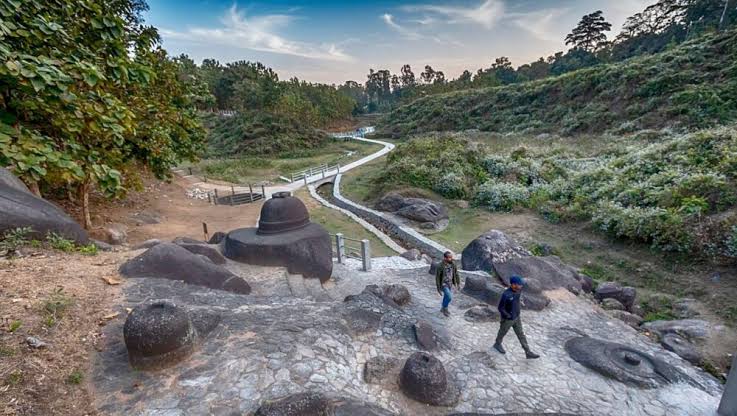
Sri Surya Pahar is the most significant archaeological landmark in the district. The site contains rock-cut sculptures, stupas, caves, Shivalingas and other archaeological remains.
The presence of artistic and religious remains associated with Hinduism, Buddhism and Jainism makes the site particularly distinctive.
Nandeswar Devalaya
Nandeswar Devalaya is an old Shiva temple situated on Nandeswar Hill beside the Dudhnoi River. The temple is traditionally believed to date to around the 10th or 11th century AD.
Tukreswari Temple
Tukreswari Temple is located on Tukreswari Hill and is an important religious destination in Goalpara.
Sri Sri Shyamrai Satra
The Shyamrai Satra is a centre of Vaishnavite religious and cultural traditions and has played an important role in preserving local heritage.
Famous Places to Visit in Goalpara
1. Sri Surya Pahar
Sri Surya Pahar is undoubtedly the star attraction of Goalpara.
The archaeological site consists of seven peaks spread across approximately 1,400 acres. It is located around 13 km from Goalpara Town and is protected by the Archaeological Survey of India as a site of national importance.
Visitors can discover rock-cut sculptures, terracotta remains, caves, stupas, Shivalingas and other archaeological features.
One of the most remarkable aspects of Sri Surya Pahar is the presence of remains connected with Hindu, Buddhist and Jain traditions within the same archaeological landscape.
The site also offers panoramic views towards the Brahmaputra and surrounding river landscape.
The annual Sri Sri Surya Mela is held here in January for three days beginning around Maghi Purnima. :contentReference[oaicite:4]{index=4}
2. Tukreswari Temple
Tukreswari Temple, also known as Tukreswari Devalaya, is an important religious attraction situated near National Highway 37, approximately 15 km from Goalpara Town.
The temple is situated on Tukreswari Hill, creating an interesting combination of spirituality and natural surroundings.
Visitors can explore the hilltop temples while enjoying the surrounding landscape. :contentReference[oaicite:5]{index=5}
3. Dadan Hill
Dadan Hill is associated with local mythology and a Shiva temple located on the hilltop.
According to local tradition, Dadan was a general of King Bana of Sonitpur and a devotee of Lord Shiva. The area is surrounded by forest, rivers and waterfalls.
The destination is especially attractive to visitors interested in mythology, trekking and nature.
4. Pir Majhar
Pir Majhar is located in the heart of Goalpara Town and is associated with the Sufi saint Hazrat Sayed Abul Kasem Kharasani.
The shrine is respected by people of different religious backgrounds, making it an important symbol of local spiritual traditions and community harmony.
5. Majar-Sharif of Pir Saheb
The Majar-Sharif of Shah Sayed Nasiruddin Kaderi, popularly known as Bagdadi, is located at Jaleswar-Katarihara, approximately 60 km by road from Goalpara Town.
An annual Uros Mubarak attracts thousands of visitors from Assam and West Bengal.
6. Sri Sri Shyamrai Satra
Located in Goalpara Town, Sri Sri Shyamrai Satra is an important centre of Vaishnavite culture.
The Satra has continued its traditions for centuries and conducts regular religious programmes and festivals.
7. Nandeswar Devalaya
Nandeswar Devalaya stands on Nandeswar Hill beside the Dudhnoi River.
Believed to be one of the older Shiva temples in the region, it is associated with festivals including Shivaratri, Durga Puja and Dol Jatra.
8. Buraburi Than
Buraburi Than is located near Jaleswar on the bank of the Brahmaputra.
The site is associated with local mythology and is notable for participation by people from different communities during religious observances.
9. Sri Sri Joybhum Kamakhya
Sri Sri Joybhum Kamakhya is a religious site located on the bank of the Brahmaputra, approximately 50 km from Goalpara Town.
The temple stands on a hillock and is associated with local Shakti traditions.
10. Urpod Beel
Urpod Beel near Agia is among the natural attractions of Goalpara.
Wetlands such as this provide an opportunity to experience the quieter natural side of the district away from its historical and religious landmarks.
11. Dhamar Risen Beel
Dhamar Risen Beel near Lakhipur is another natural attraction listed by the district administration.
Its wetland environment makes it relevant for visitors interested in nature and local landscapes.
12. Tukreswari and Rakhyashini Hills
The hills of Goalpara, including Tukreswari and Rakhyashini, are suitable for visitors interested in outdoor exploration, trekking and rock climbing.
The district administration particularly highlights these hills for their scenic landscapes and rock formations. :contentReference[oaicite:6]{index=6}
Famous Food to Try in Goalpara
Goalpara's food culture reflects the wider culinary traditions of Assam and the communities living across Lower Assam.
Assamese Rice-Based Meals
Rice forms an important part of everyday Assamese food. A traditional meal may include rice, dal, vegetables, fish and locally prepared side dishes.
Masor Tenga
Masor Tenga is one of Assam's best-known fish preparations, appreciated for its light and tangy flavour.
Pitika
Pitika refers to simple mashed preparations made with ingredients such as potatoes, vegetables or fish and served with rice.
Local Fish Preparations
With the Brahmaputra and other rivers influencing the region's food culture, fish remains an important ingredient in traditional meals.
- Rice and dal
- Masor Tenga
- Aloo Pitika
- Fish preparations
- Seasonal vegetables
- Assamese-style chutneys and sides
- Traditional snacks
For an authentic experience, travellers should explore local eateries and traditional Assamese meals rather than limiting themselves to standard restaurant menus.
Famous Personalities and Historical Figures Connected with Goalpara
Hiuen Tsang
The Chinese traveller Hiuen Tsang is mentioned in historical discussions concerning the ancient region of Assam. His accounts were later considered by historians such as Sir Edward Gait while examining the possible location of the ancient capital associated with Kumar Bhaskar Varman.
Dadan
Dadan is a legendary figure associated with Dadan Hill. Local tradition identifies him as a general of King Bana of Sonitpur and a devotee of Lord Shiva.
Hazrat Sayed Abul Kasem Kharasani
Hazrat Sayed Abul Kasem Kharasani is the Sufi saint associated with Pir Majhar in Goalpara Town.
Shah Sayed Nasiruddin Kaderi
Shah Sayed Nasiruddin Kaderi, popularly known as Bagdadi, is associated with the Majar-Sharif at Jaleswar-Katarihara.
Some of Goalpara's historical and religious figures are preserved through local traditions, legends and oral histories. Such accounts should therefore be distinguished from independently verified historical records.
Festivals Celebrated in Goalpara
Surya Mela
The Sri Sri Surya Mela is held at Sri Surya Pahar every January around Maghi Purnima and attracts large numbers of devotees and visitors.
Bihu
Bihu is among Assam's most important cultural festivals and is celebrated with music, dance, food and community gatherings.
Shivaratri
Shivaratri is particularly important at Shiva temples such as Nandeswar Devalaya and Dadan Hill.
Dol Jatra
Dol Jatra is celebrated at religious institutions and forms part of the Vaishnavite cultural calendar.
Uros Mubarak
The annual Uros Mubarak at the Majar-Sharif of Pir Saheb brings together devotees from different places.
Navratri and Durga Puja
Navratri and Durga Puja are celebrated across the district with religious ceremonies and community activities.
Things to Do in Goalpara
- Explore Sri Surya Pahar and discover its archaeological remains.
- Study ancient rock-cut sculptures depicting different religious traditions.
- Visit Tukreswari Temple and explore its hilltop surroundings.
- Visit Dadan Hill for its mythology, temple and natural landscape.
- Visit Pir Majhar in Goalpara Town.
- Explore Sri Sri Shyamrai Satra and learn about Vaishnavite traditions.
- Visit Nandeswar Devalaya and experience its historic setting.
- Explore the Brahmaputra landscape around Goalpara.
- Visit Urpod Beel for a quieter nature experience.
- Explore Dhamar Risen Beel near Lakhipur.
- Go trekking in suitable hill areas.
- Try traditional Assamese food at local eateries.
- Explore local markets and experience everyday life in Goalpara.
- Visit during a local festival for a deeper cultural experience.
- Take a scenic road trip through Goalpara's countryside.
Where to Eat, Shop and Stay in Goalpara
Where to Eat
Goalpara Town is the most convenient place to find restaurants and local food options.
Travellers looking for a regional experience can try:
- Traditional Assamese rice meals
- Fish preparations
- Masor Tenga
- Pitika
- Seasonal vegetables
- Local snacks
Where to Shop
Local markets in Goalpara provide a chance to experience the everyday commercial life of Lower Assam.
Depending on the market and season, travellers may find:
- Traditional Assamese textiles
- Handloom products
- Bamboo and cane products
- Local agricultural produce
- Traditional food products
Where to Stay
Goalpara Town is the most practical base for travellers exploring attractions around the district headquarters.
For destinations farther away, such as Jaleswar or attractions around the southern and western parts of the district, travellers should plan their accommodation according to their itinerary.
| Accommodation Type | Best For |
|---|---|
| Hotels | Families and regular tourists |
| Budget Accommodation | Backpackers and short stays |
| Guest Houses | Budget-conscious travellers |
| Town Accommodation | First-time visitors and sightseeing trips |
What is Goalpara Famous For?
Goalpara is famous for its archaeological heritage, hills, temples, rivers, cultural diversity and Sri Surya Pahar.
- Sri Surya Pahar
- Tukreswari Temple
- Dadan Hill
- Nandeswar Devalaya
- Pir Majhar
- Sri Sri Shyamrai Satra
- Joybhum Kamakhya
- Buraburi Than
- Urpod Beel
- Dhamar Risen Beel
- Brahmaputra river landscape
- Rabha and other local cultural traditions
Among these, Sri Surya Pahar stands out because of its unusual combination of archaeological remains associated with Hinduism, Buddhism and Jainism. :contentReference[oaicite:7]{index=7}
Best Time to Visit Goalpara
The best time to visit Goalpara is generally from October to April, when the weather is more suitable for sightseeing and outdoor exploration.
The winter months are particularly comfortable for visiting archaeological sites, temples and hill areas.
Monsoon can transform the surrounding landscape into a lush green setting, but travellers should consider rainfall and local road conditions before planning outdoor activities.
| Season | Months | Travel Experience |
|---|---|---|
| Winter | October–February | Excellent for sightseeing and outdoor exploration |
| Spring | February–April | Comfortable for sightseeing and cultural visits |
| Summer | April–June | Warm; outdoor activities are better planned for mornings/evenings |
| Monsoon | June–September | Green landscapes but heavy rain can affect travel |
Best overall period: October to April.
Best for cultural events: Festival dates vary according to the religious and Assamese calendar, so check locally before planning around a specific event.
How to Reach Goalpara
By Air
The nearest major air gateway for Goalpara travellers is generally Lokpriya Gopinath Bordoloi International Airport in Guwahati.
From Guwahati, travellers can continue towards Goalpara by road or rail.
By Train
Goalpara is connected to the wider Assam railway network. Goalpara Town and other nearby railway stations can be used depending on the traveller's route and train availability.
By Road
Road travel is one of the most practical ways to explore Goalpara and its surrounding attractions.
Travellers coming from Guwahati and other parts of Lower Assam can reach Goalpara by road and then continue to individual tourist destinations.
| Mode | Best Option |
|---|---|
| Air | Guwahati Airport |
| Train | Goalpara-area railway connections |
| Road | Guwahati–Goalpara and regional road routes |
Travel tip: If your itinerary includes Sri Surya Pahar, Tukreswari, Dadan Hill and other attractions spread across the district, a private vehicle or hired car can be more convenient than relying entirely on public transport.
Nearby Places to Visit from Goalpara
Guwahati
Guwahati is the largest urban centre in Assam and an important transport gateway for travellers visiting Goalpara.
Meghalaya's Garo Hills
The southern boundary of Goalpara meets the Garo Hills region of Meghalaya, making the broader area interesting for travellers who enjoy hills and nature.
Dhubri
Dhubri lies to the west of Goalpara and can be included in a broader Lower Assam itinerary.
Kamrup
Kamrup district lies to the east and provides additional cultural and natural attractions for an extended Assam trip.
Best Duration for a Goalpara Trip
A 2-day trip is enough for a quick introduction to Goalpara and some of its major attractions.
A 3-day itinerary provides more time for archaeological sites, temples, hills and cultural experiences.
If you want to explore the district at a slower pace and include more distant attractions, 4 days is a better choice.
| Duration | Suggested Plan |
|---|---|
| 1 Day | Goalpara Town + nearby religious and cultural sites |
| 2 Days | Goalpara + Sri Surya Pahar + Tukreswari |
| 3 Days | Heritage + temples + hills + local culture |
| 4 Days | Extended Goalpara exploration at a relaxed pace |
Travel Tips for Goalpara
- Start early: Begin sightseeing early when visiting multiple attractions in one day.
- Wear comfortable footwear: Useful for hilltop temples, archaeological sites and uneven terrain.
- Carry drinking water: Especially when travelling to less-developed or remote attractions.
- Respect heritage sites: Do not touch, damage or remove archaeological objects.
- Respect religious customs: Follow local rules at temples, satras, shrines and mazars.
- Check weather conditions: Rain can affect road travel during the monsoon.
- Carry some cash: Smaller towns and remote attractions may have limited digital payment options.
- Ask before photography: Particularly when photographing people or religious ceremonies.
- Keep the environment clean: Take your waste back with you.
- Use local guidance: Local knowledge can be helpful when exploring lesser-known sites.
- Plan transportation: Attractions are spread across the district, so plan routes before leaving.
- Keep the itinerary flexible: Weather and local conditions can affect outdoor plans.
Why Visit Goalpara?
Goalpara is ideal for travellers who want to discover a quieter and culturally rich side of Assam.
Unlike destinations that rely on a single major attraction, Goalpara offers a combination of:
- Archaeological tourism – Sri Surya Pahar and ancient remains.
- Religious tourism – temples, satras, mazars and shrines.
- Nature tourism – hills, rivers, wetlands and forests.
- Cultural tourism – Rabha and other local traditions.
- Adventure tourism – trekking and rock-climbing opportunities in suitable hill areas.
- Road-trip experiences – scenic countryside and rural Assam.
The district administration describes Goalpara as a region endowed with natural beauty and archaeological treasures, with Sri Surya Pahar, Dadan Hill, Tukreswari, Urpod Beel and several religious sites among its attractions. :contentReference[oaicite:8]{index=8}
Conclusion
Goalpara, Assam, is a destination where history, spirituality and nature come together.
From the ancient archaeological landscape of Sri Surya Pahar to the hilltop temples of Tukreswari and Nandeswar, the district offers a fascinating mix of experiences.
Its connection with the Brahmaputra, Garo Hills, Rabha culture, Vaishnavite traditions and historic religious sites gives Goalpara an identity that is distinctly different from more commercialised tourist destinations in Assam.
For travellers interested in heritage, archaeology, temples, nature, culture and offbeat Assam, Goalpara deserves a place on the travel map.
If you want to experience a lesser-explored side of Assam, plan a trip to Goalpara and discover the stories hidden among its hills, rivers, temples and ancient ruins.
"Travel is the only thing you buy that makes you richer."